People didn't want a handyman app. They wanted to trust the person coming into their home.
Sahay is a trust-first home-maintenance platform: a concept for confident repair decisions from the moment something breaks through to aftercare. It looks like a logistics problem, but the harder problem underneath is trust, letting a stranger into your home.
"Home maintenance isn't really about the task. It's about who you let in."
I worked on Sahay as a three-person capstone team with Swetha Thanabalan and Joshua Phillips. The idea came from one of our own experiences as a first-time homeowner, overwhelmed by unfamiliar electrical, heating, and plumbing systems, in a category full of scams and inconsistent service.
Our problem statement: people living independently struggle to identify home maintenance issues and don't know who to trust for help, leading to stress, wasted time, and poor decisions. Sahay helps homeowners understand the issue, choose DIY or professional support, find trustworthy providers, and stay ahead of future maintenance.
"I looked at where people got stuck between 'something's wrong' and 'someone fixed it.'"
8 homeowner interviews across the US, affinity-mapped as a team in FigJam.
16-response survey, distributed on Reddit (r/DIY, r/HomeMaintenance, r/FirstTimeHomeBuyer, r/HomeImprovement, and others) and through homeowner associations.
Competitive scan of 6 platforms (TaskRabbit, Urban Company, Angi/HomeAdvisor, Thumbtack, YouTube) against 8 criteria, from user education to aftercare. I ran interviews, owned the survey, and led the teardown of TaskRabbit and Urban Company.
Observed
Homeowners weighed DIY-vs-professional decisions less on skill and more on how much they trusted their own read of the problem. Uncertainty about diagnosis pushed people toward calling someone, even for small issues.
92%wanted pricing upfront, before booking anyone, the single most consistent frustration across the survey and interviews.
75%owned their home, most older than 6 years
64%knew who to call when something broke
57%tried to fix it themselves first
79%trust a referral over any app
Every marketplace told the same story: strong on booking, weak on trust and education.
Observed
Only YouTube taught people what was wrong before they acted, through rich, symptom-based tutorials with no pressure to hire anyone.
"Vetted" providers weren't consistently vetted. Angi's own bar for a badge was as low as a single 3-star review.
TaskRabbit, Thumbtack, and HomeAdvisor buried users in forms asking for repair duration or contact details before showing any real value.
Not one platform had a real emergency flow or a structured aftercare step. Once a job was booked, the relationship ended there.
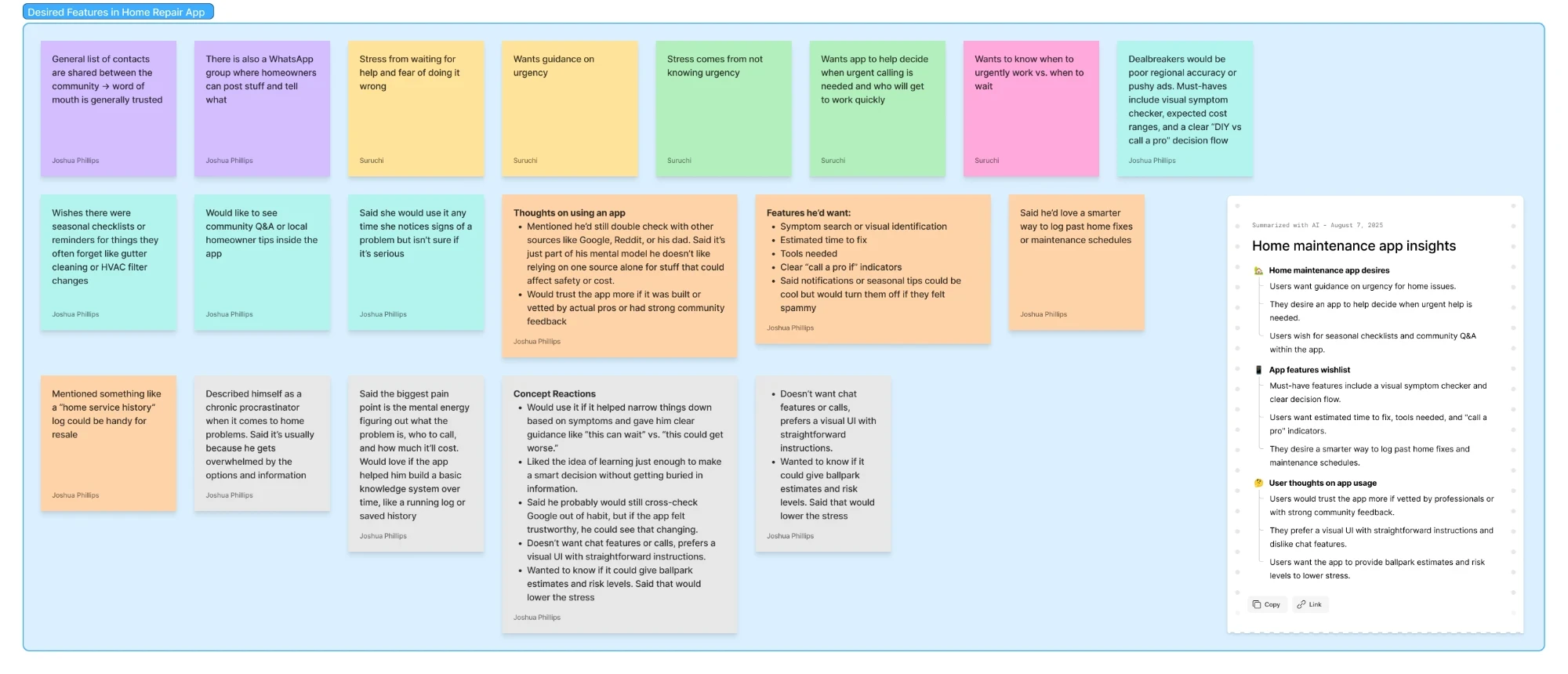
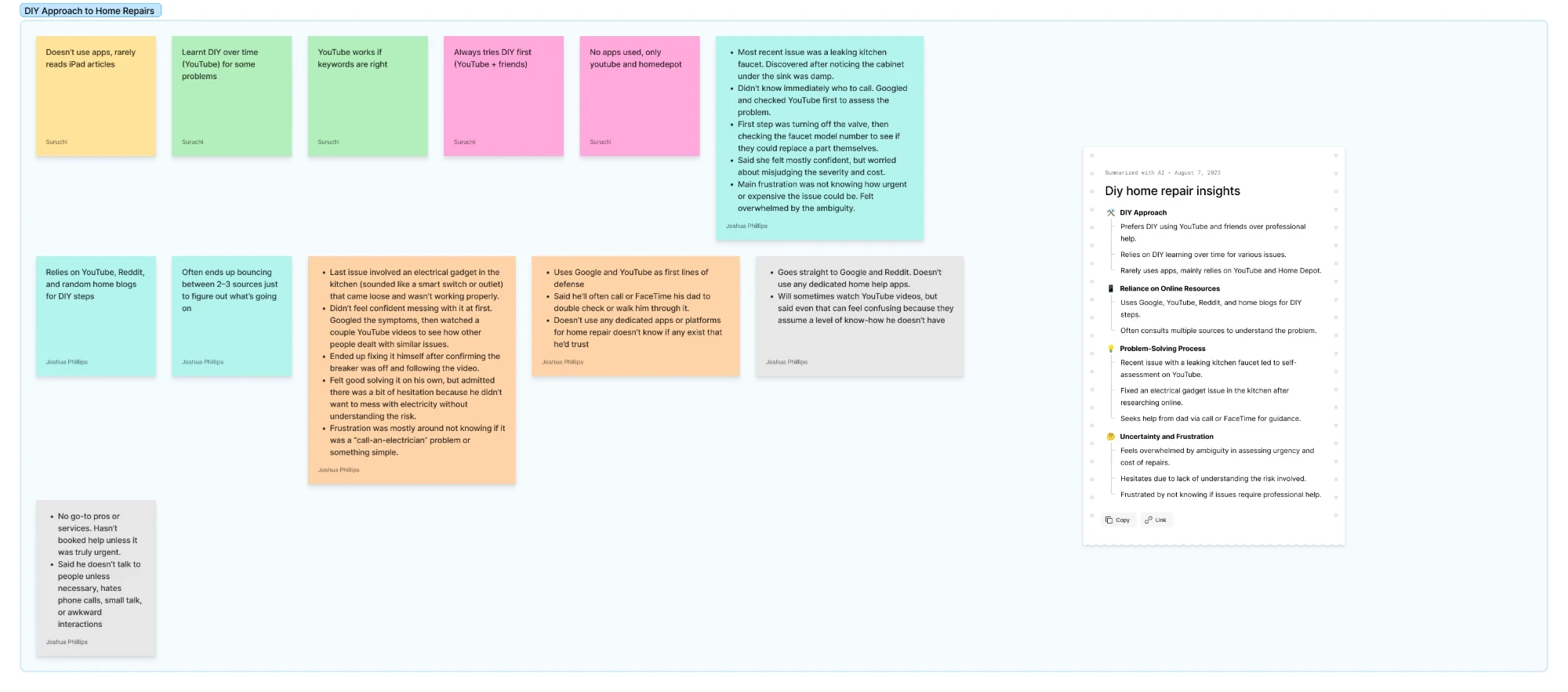
Research synthesis, straight from our FigJam boards:
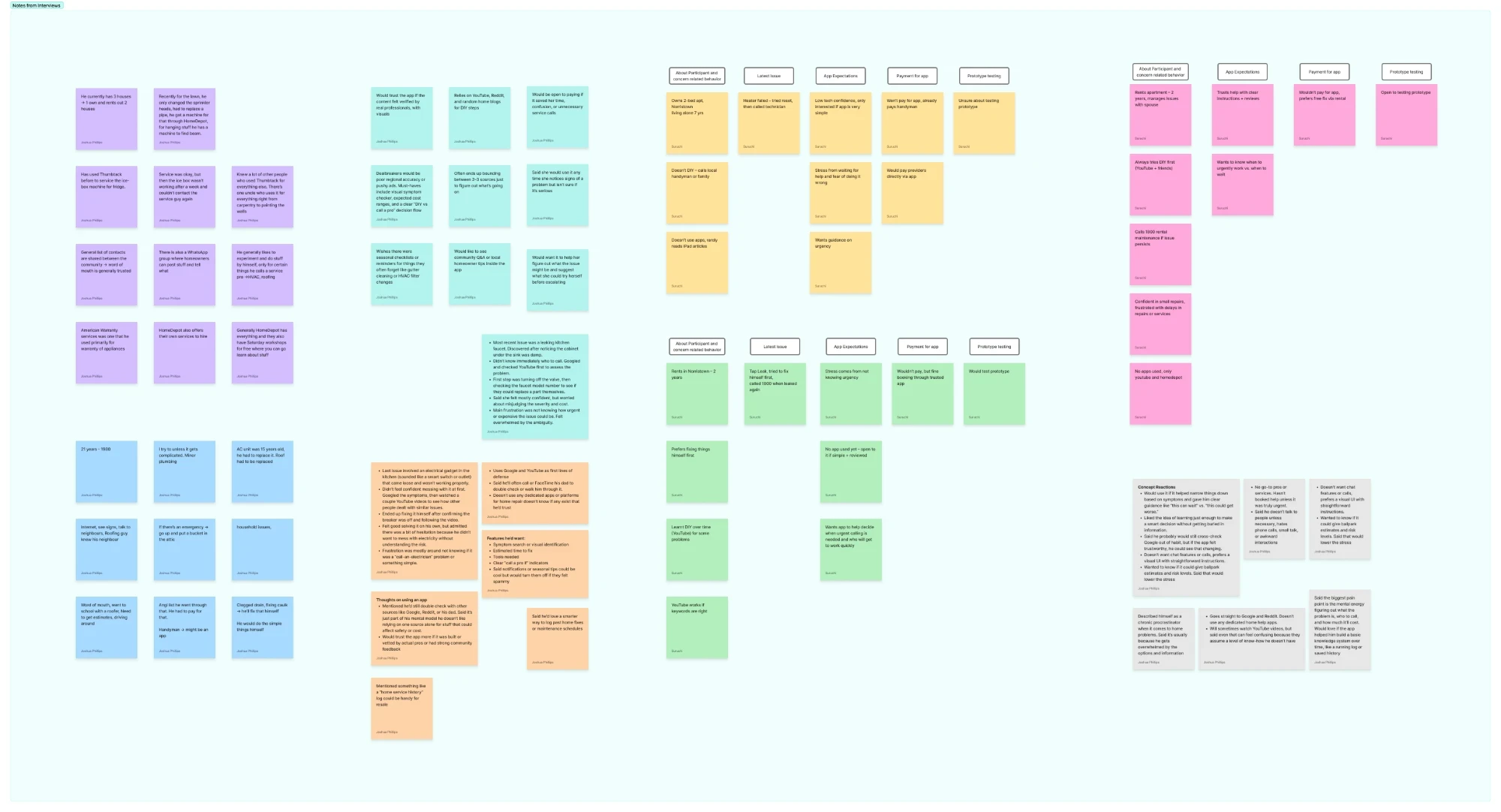
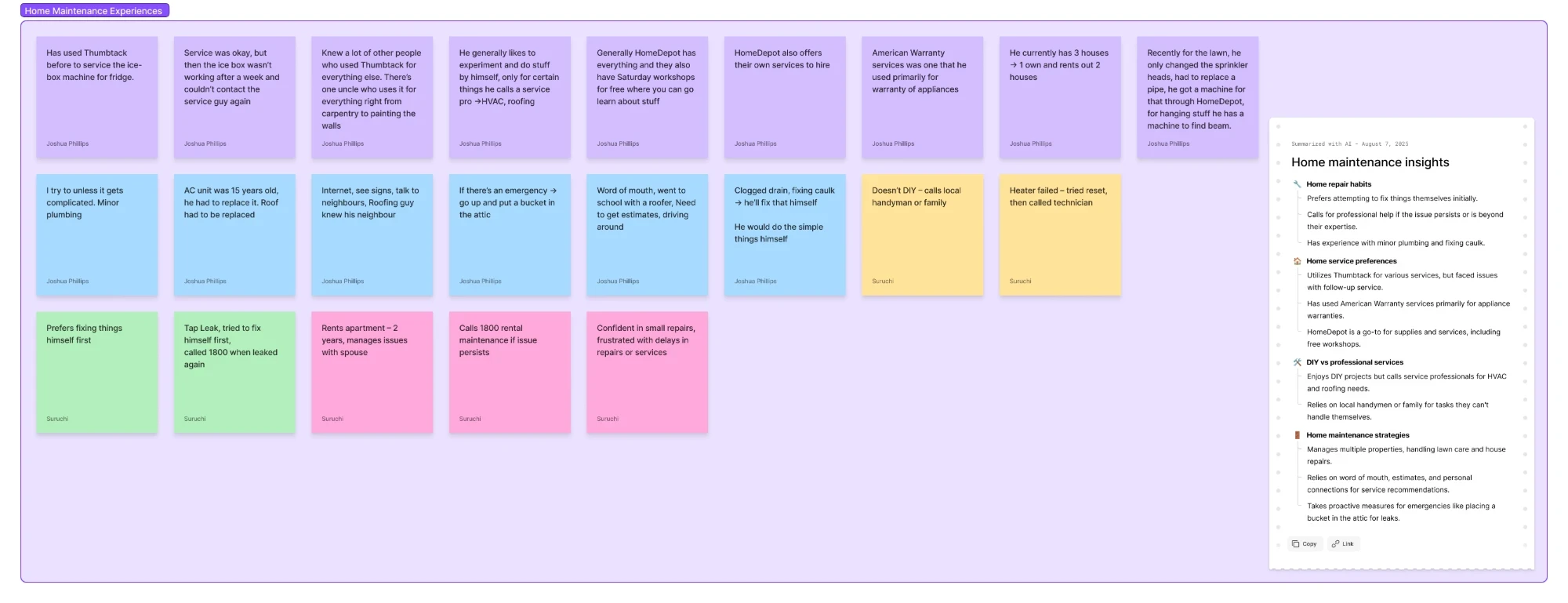
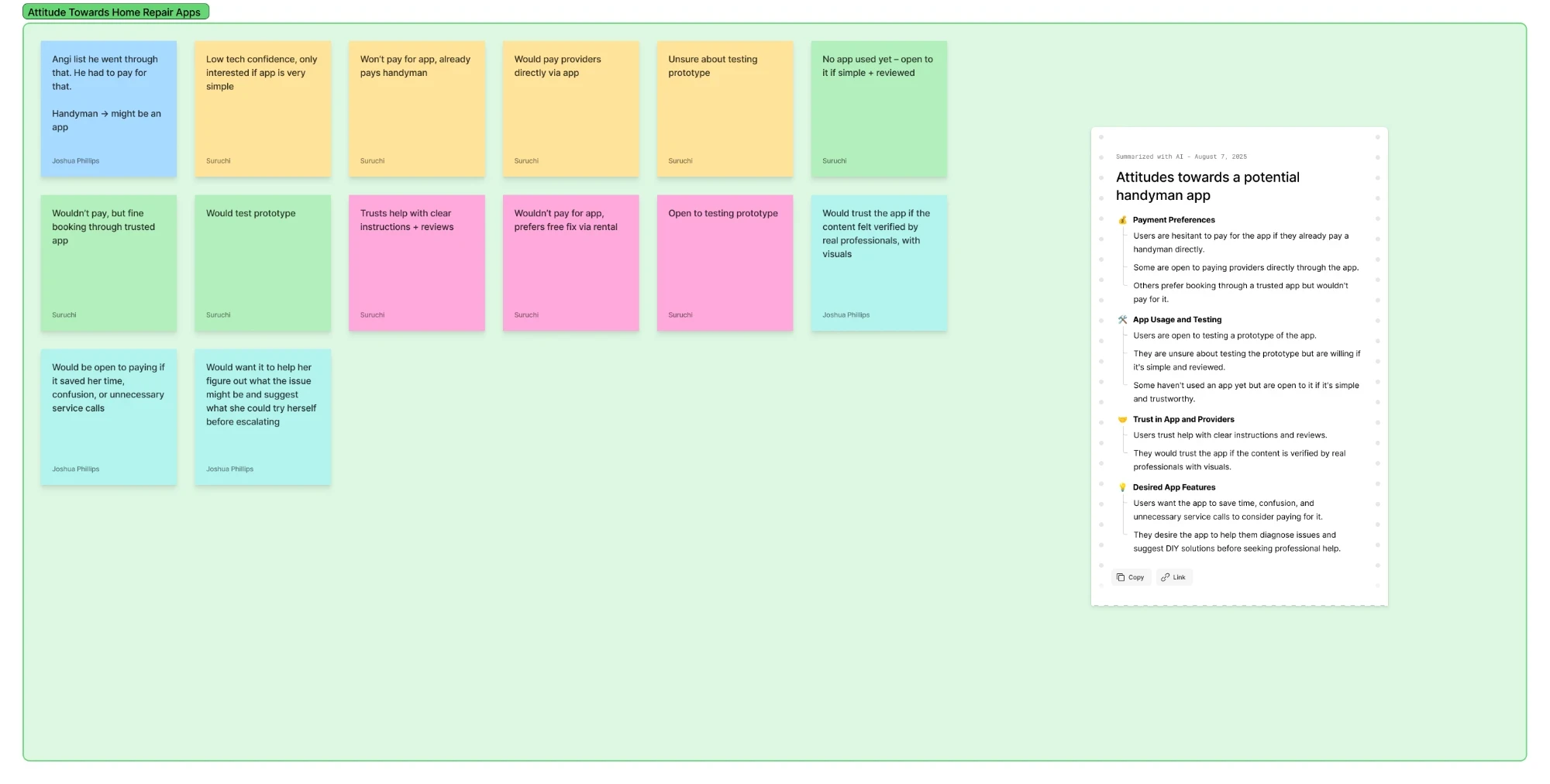
Raw notes from all 8 interviews, color-coded by team member.Affinity group: home maintenance experiences and habits.Affinity group: attitudes toward paying for and trusting a home-repair app.Affinity group: the features people asked for unprompted.Affinity group: how people actually DIY today.
Who we designed for
Three homeowners, three very different relationships with trust.
Interview and survey findings converged into three personas that shaped every flow that followed.
A
Alex
42 · Business Analyst · First-time homeowner, Boston suburbs
Family-oriented, juggling work and parenting in a newly purchased 25-year-old house. Not particularly handy or tech-savvy. Wants clear information, reliable recommendations, efficient solutions.
How he'd use Sahay
Spots a water stain on the ceiling. Uploads a photo to Sahay's symptom checker instead of Googling, gets a plain-language read (minor roof leak, address within a week), a confirmation checklist, pre-vetted roofers, a follow-up reminder, and a cost range so he isn't blindsided.
E&R
Emma & Ryan
29 & 31 · UX Designer & Data Analyst · Condo, Philadelphia
A young couple with packed weekdays and no time for leaking faucets. Ryan researches reviews and comparisons; Emma wants things that just work. Cautious but capable.
How they'd use Sahay
Heating feels off, guests coming that evening. They run a quick symptom check together instead of five browser tabs. Sahay suggests a thermostat issue with a confidence rating, surfaces HVAC experts free that weekend, gives an upfront estimate. They bookmark the seasonal checklist for next month.
D
David Patel
49 · Accountant & landlord · 2 rental properties
Financially savvy, uninterested in micromanaging tenants. Finds renters a mixed bag: reliable grad students vs. unpredictable undergrads. Wants fewer late-night emergencies.
How he'd use Sahay
Tenants text at midnight that the heat is out. With Sahay, they submit through guided prompts, try safe first steps, and only route to David automatically if it persists, arriving with a diagnostic guess and vetted contractors already attached.
"Trust had to be designed, not assumed."
Inferred
Speed and price weren't the real decision drivers. Underneath both was control, whether someone felt they understood their own home well enough to say yes. Transparency gave that control back.
A real tension: people wanted a smart AI, but several said they preferred a visual interface and disliked chat-only experiences. Conversational AI couldn't be the only way in.
"I designed around a clearer path from problem to resolution."
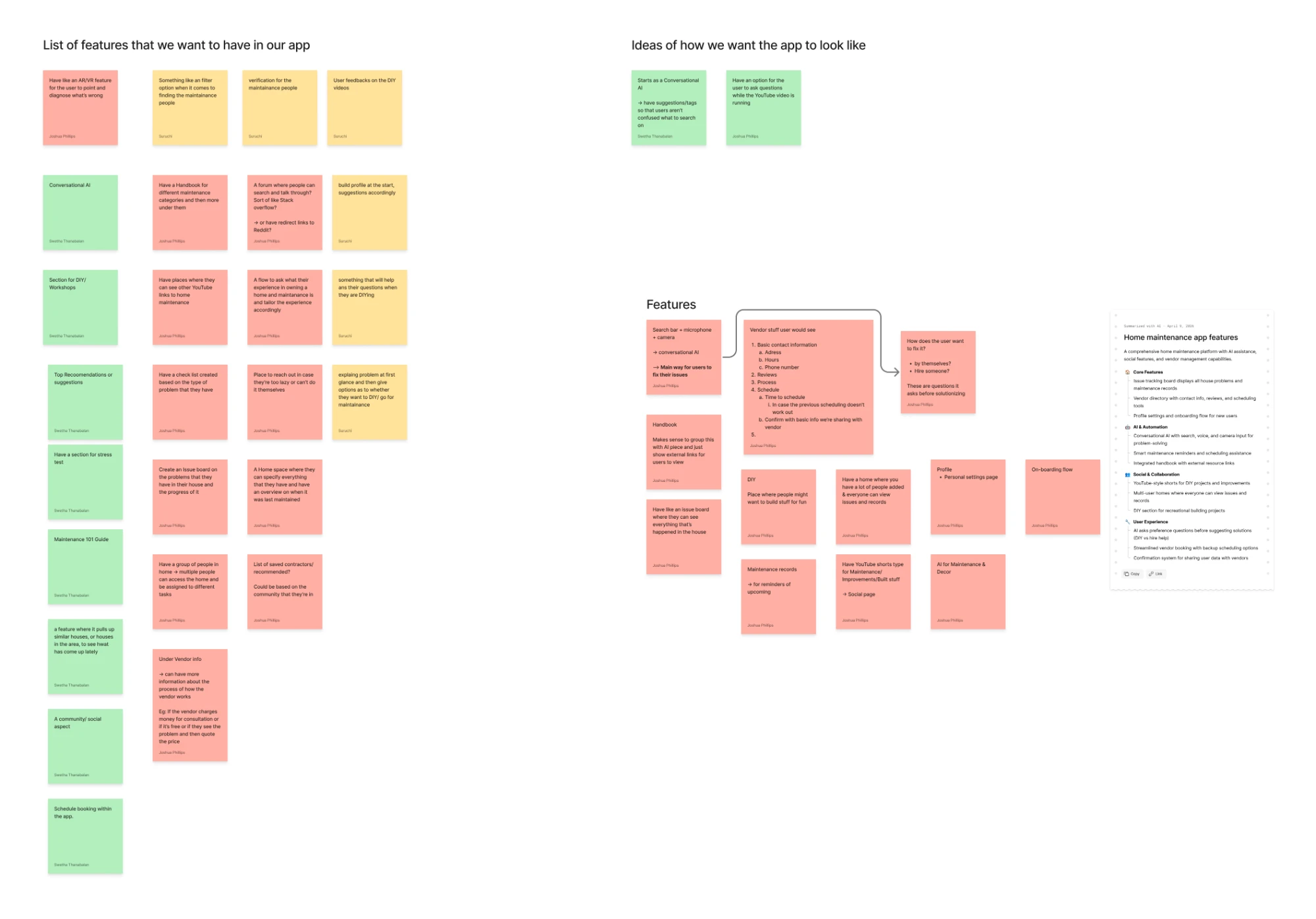
Research synthesis fed a team feature brainstorm across two boards, one for desired features, one for how the app should feel, then four buckets that became the product's information architecture.
Early feature ideation, sorted from a raw sticky-note dump into the core flows that shaped the prototype.
Core features: issue-tracking board, vendor directory with reviews and scheduling, onboarding for new homes.
AI & automation: conversational AI with search, voice, and camera input, smart maintenance reminders, a linked handbook.
Social & collaboration: YouTube-shorts-style DIY clips, multi-user homes with shared visibility.
User experience: AI asks DIY-or-hire preference before suggesting a path; booking includes backup scheduling.
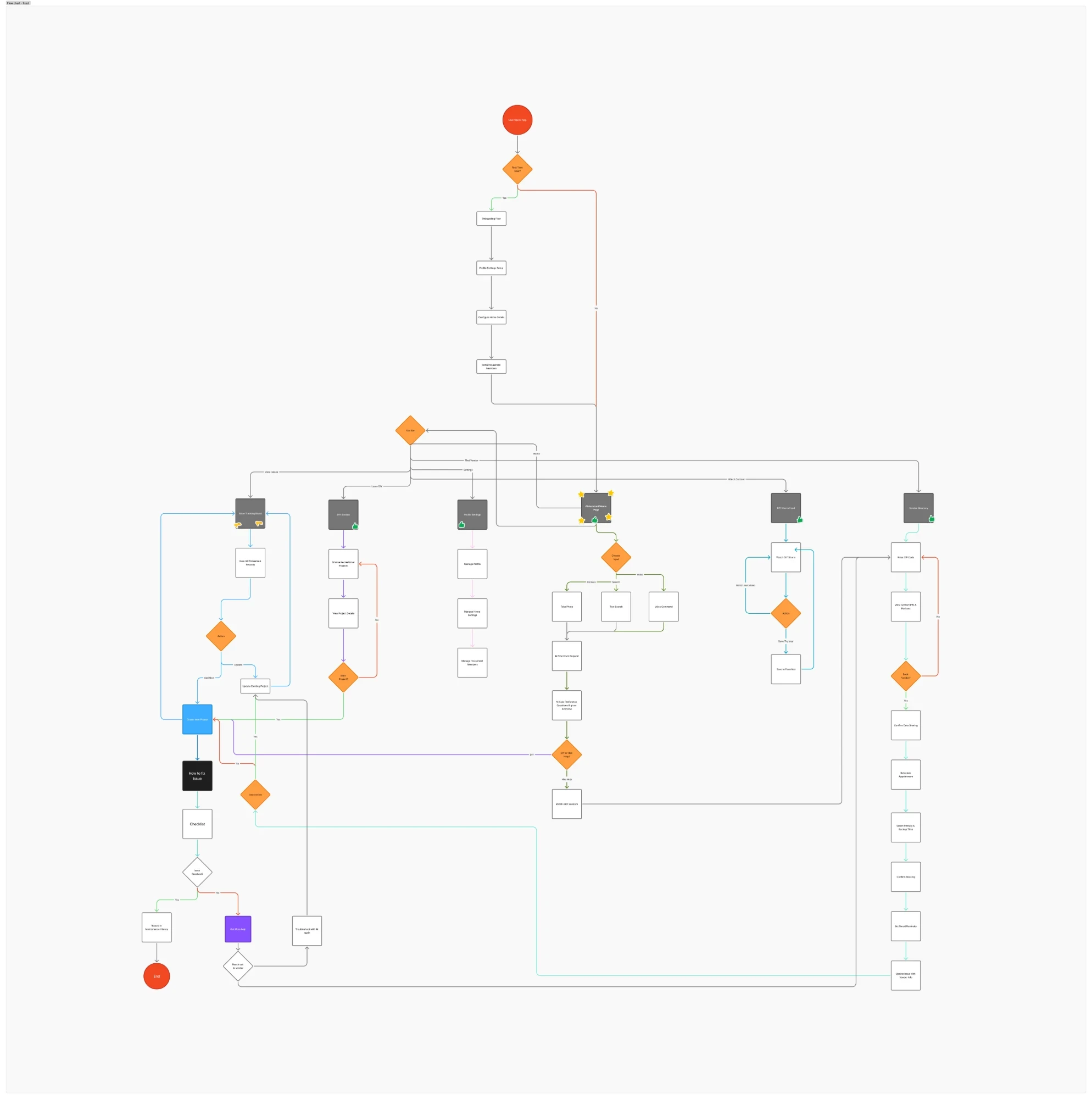
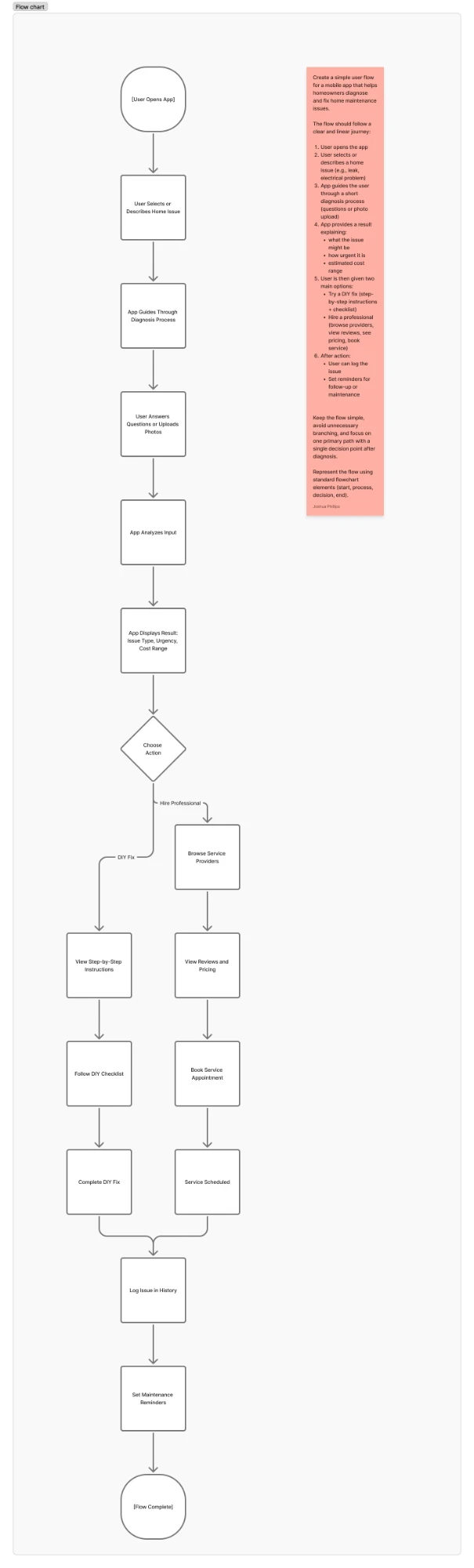
That logic became two flows: the full app map, and the simplified path from symptom to resolution.
The full app flow: onboarding through issue tracking, DIY, and vendor booking.The simplified version: one primary path, one decision point.
Click a factor below to see the design decision it led to.
Designed
An AI-assisted diagnosis flow that gives homeowners a plain-language read on what's likely wrong before they decide whether to attempt it themselves or book a professional.
Designed
Provider matching and booking flows that surface pricing and provider information upfront, rather than after a request is already in motion.
Designed
Transparent provider profiles and status updates throughout the repair, so homeowners always know what's happening and why, rather than waiting on a black box.
Designed
A structured, photo-based symptom checker as the default entry point, with the conversational AI available alongside it rather than as the only way in.
The prototype
From "what's going on?" to "it's handled."
A walkthrough of the built prototype, followed by every screen, grouped by flow.
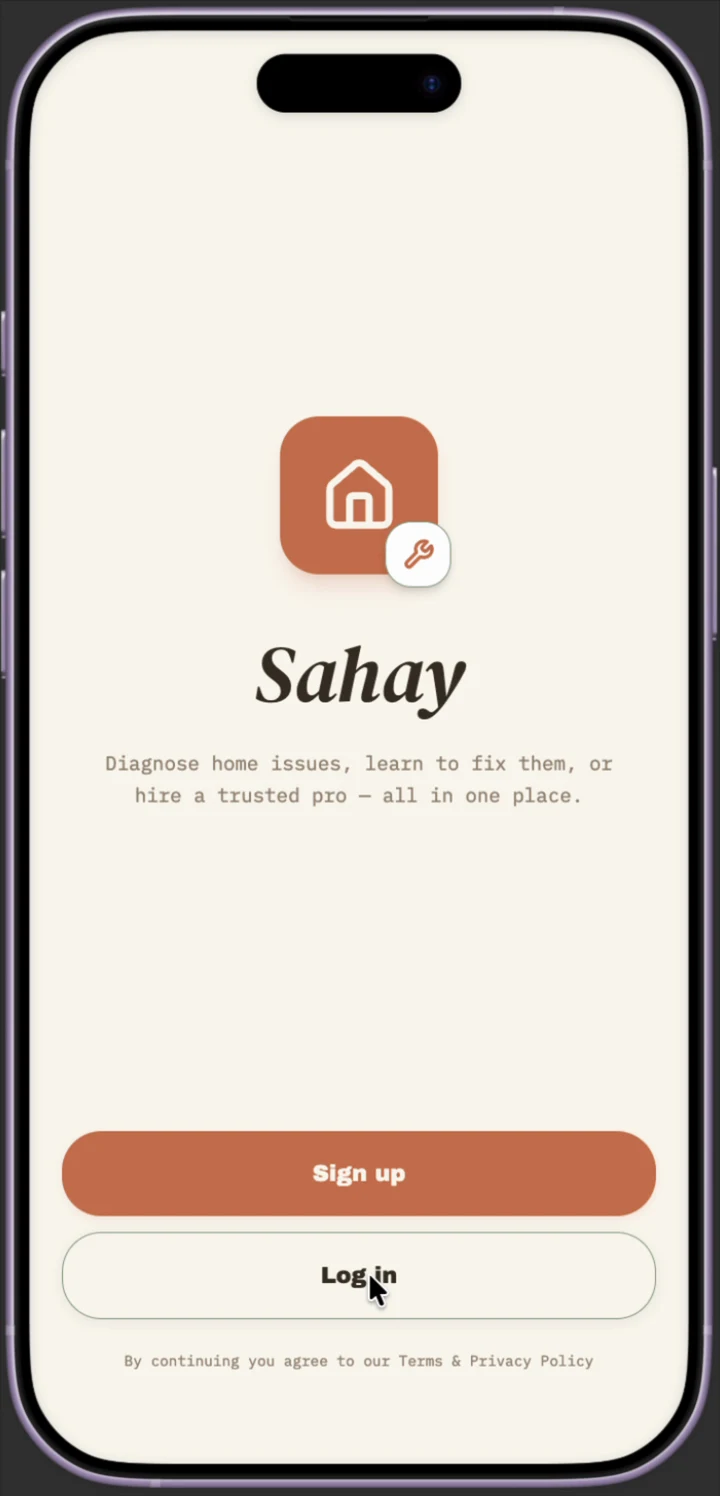
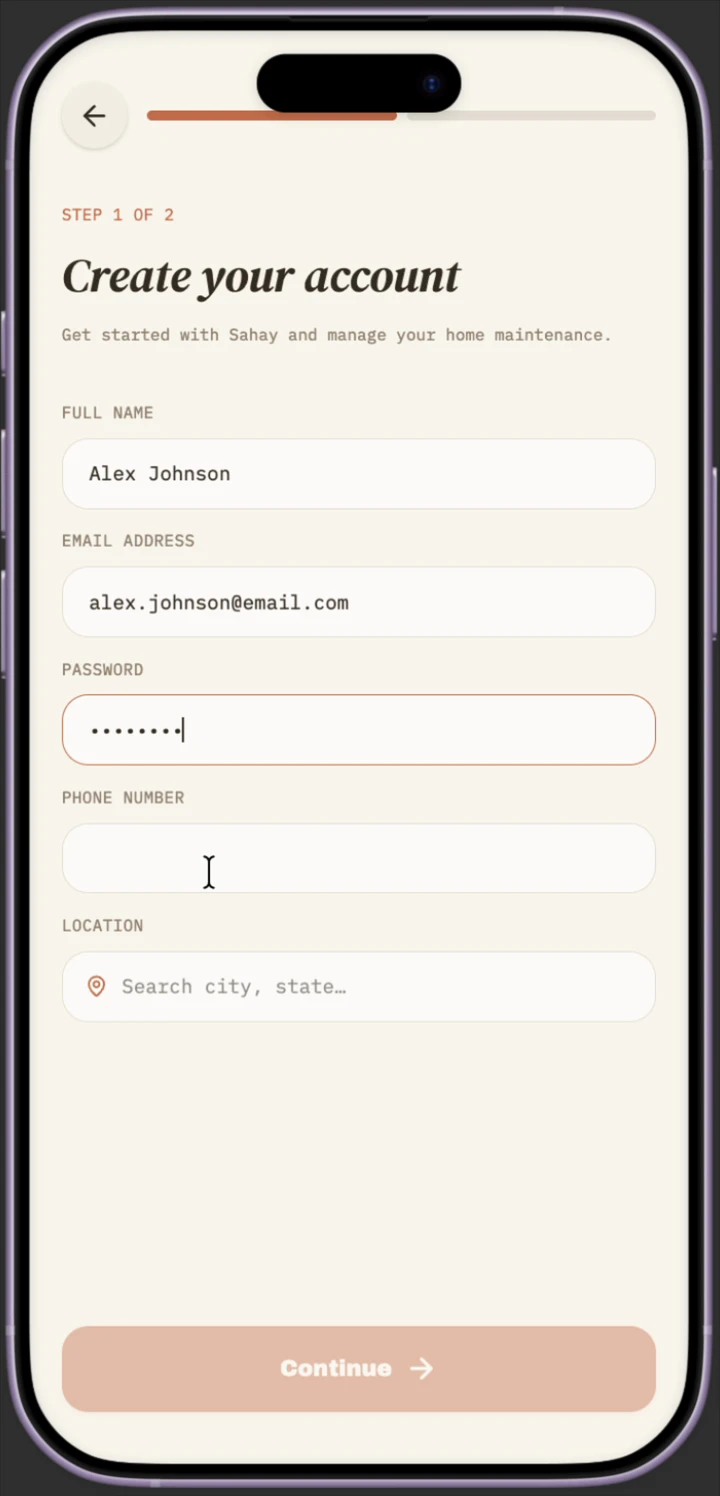
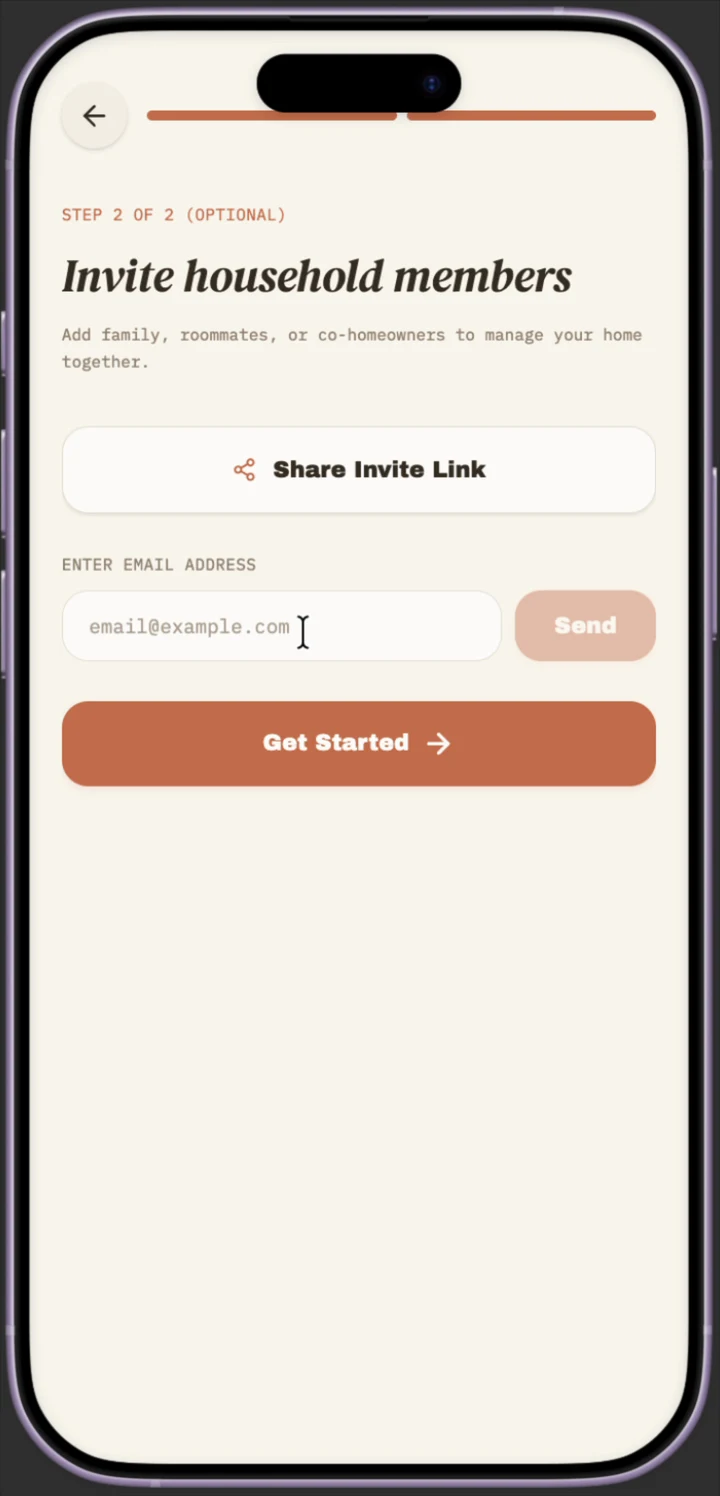
A full click-through of the prototype, onboarding to a booked repair.
Onboarding
WelcomeCreate accountInvite household members
Diagnosing an issue
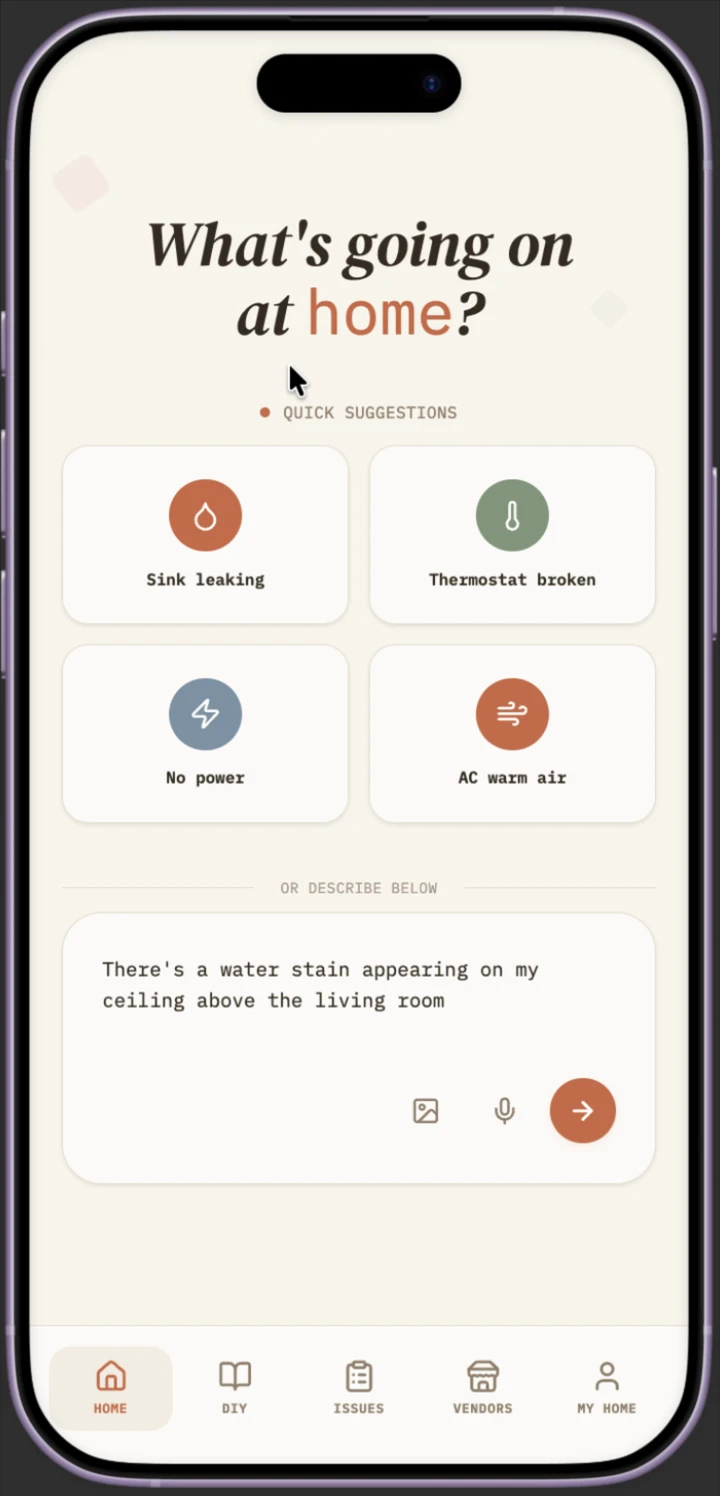
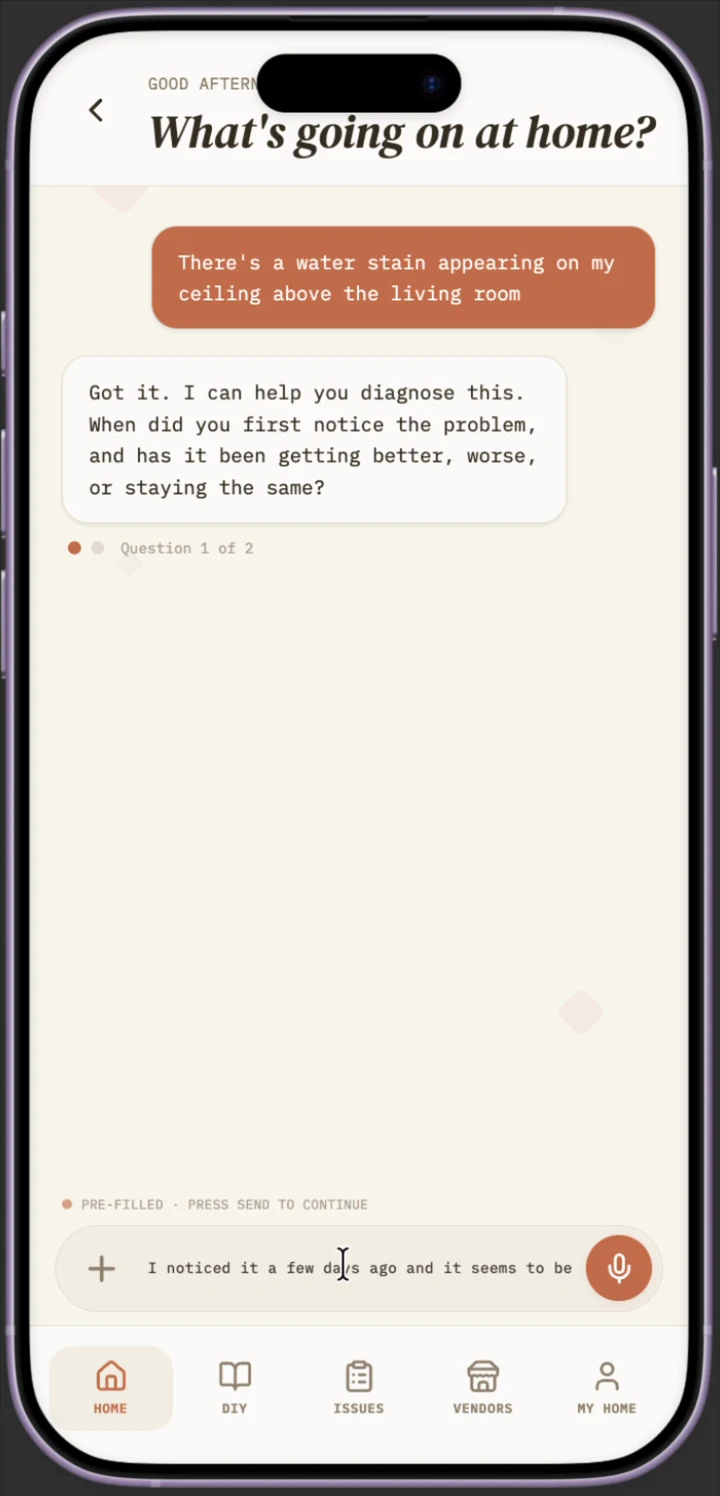
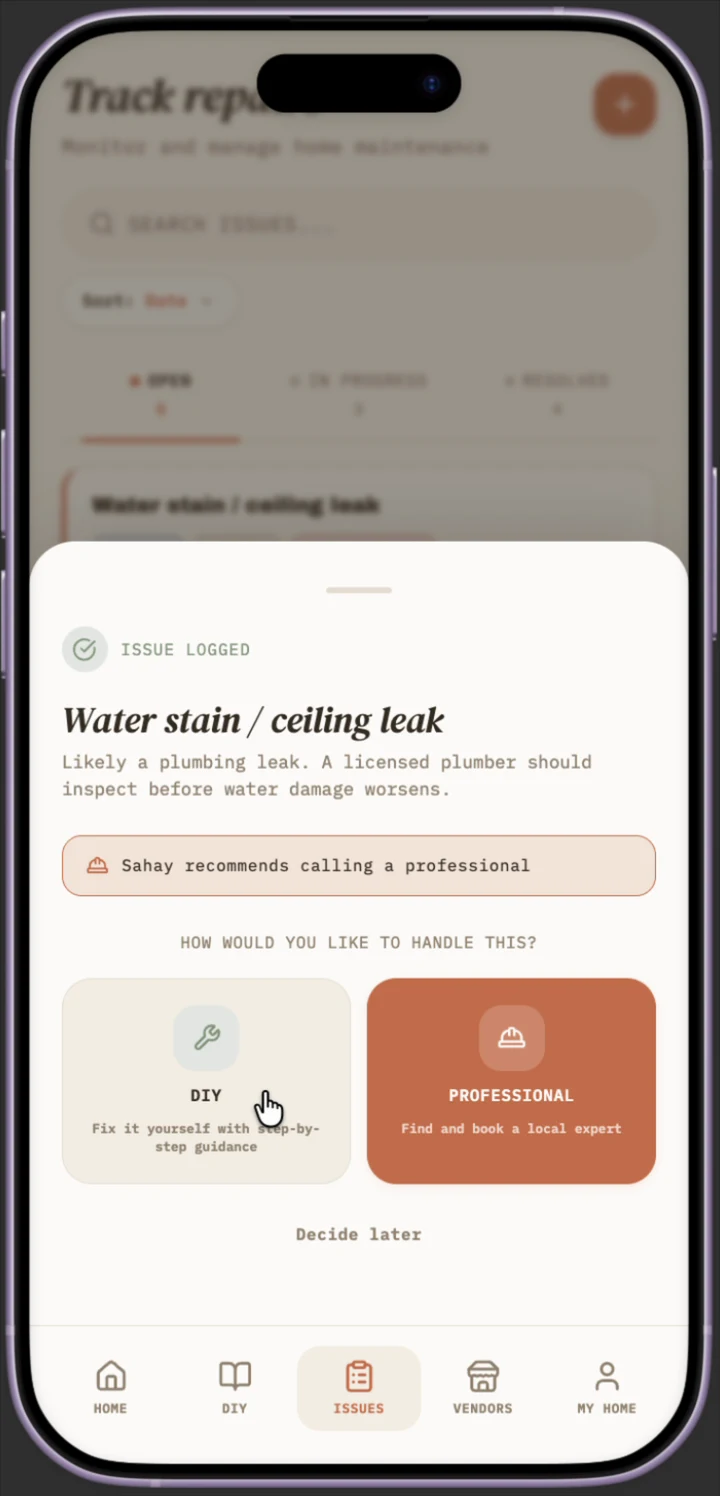
Home: quick suggestions or describe the issueAI asks follow-up questions to narrow the diagnosisDiagnosis delivered, DIY or professional
Going the DIY route
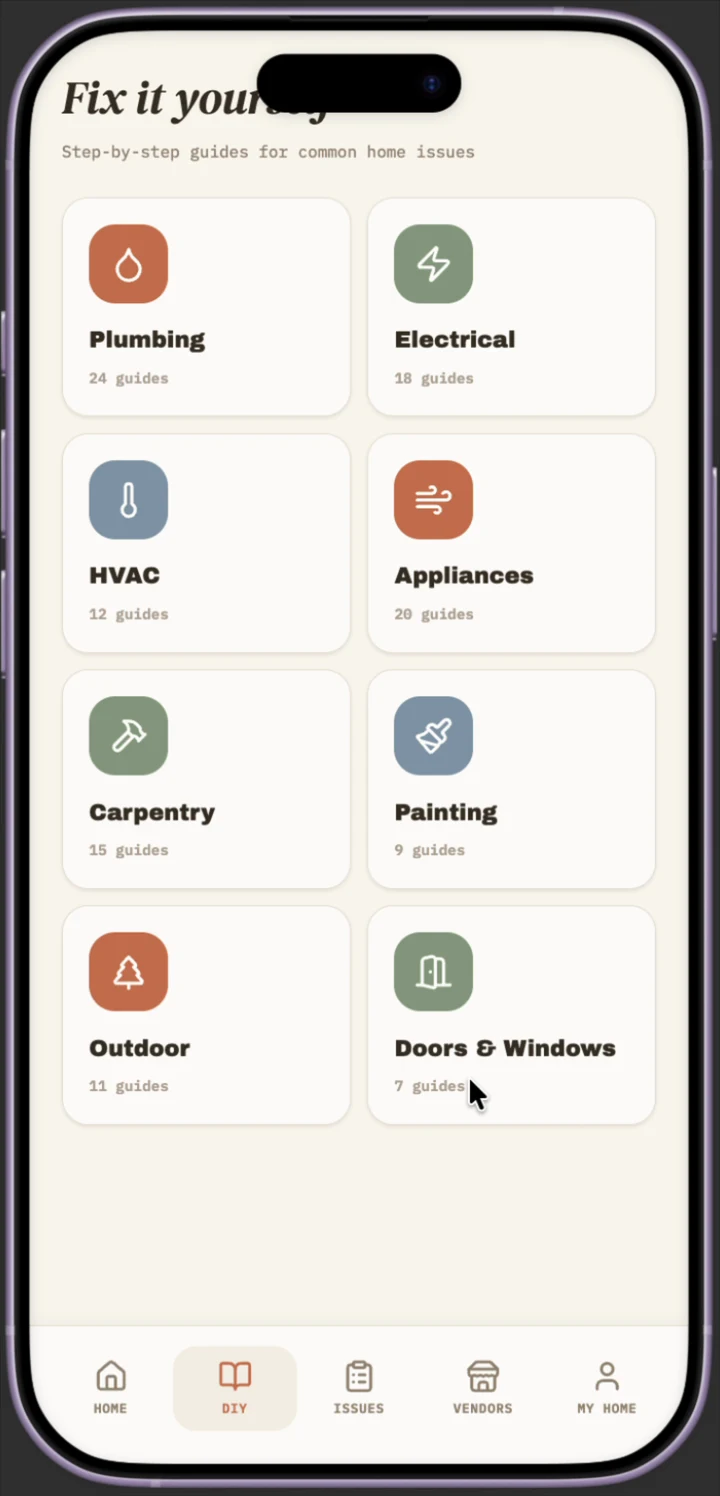
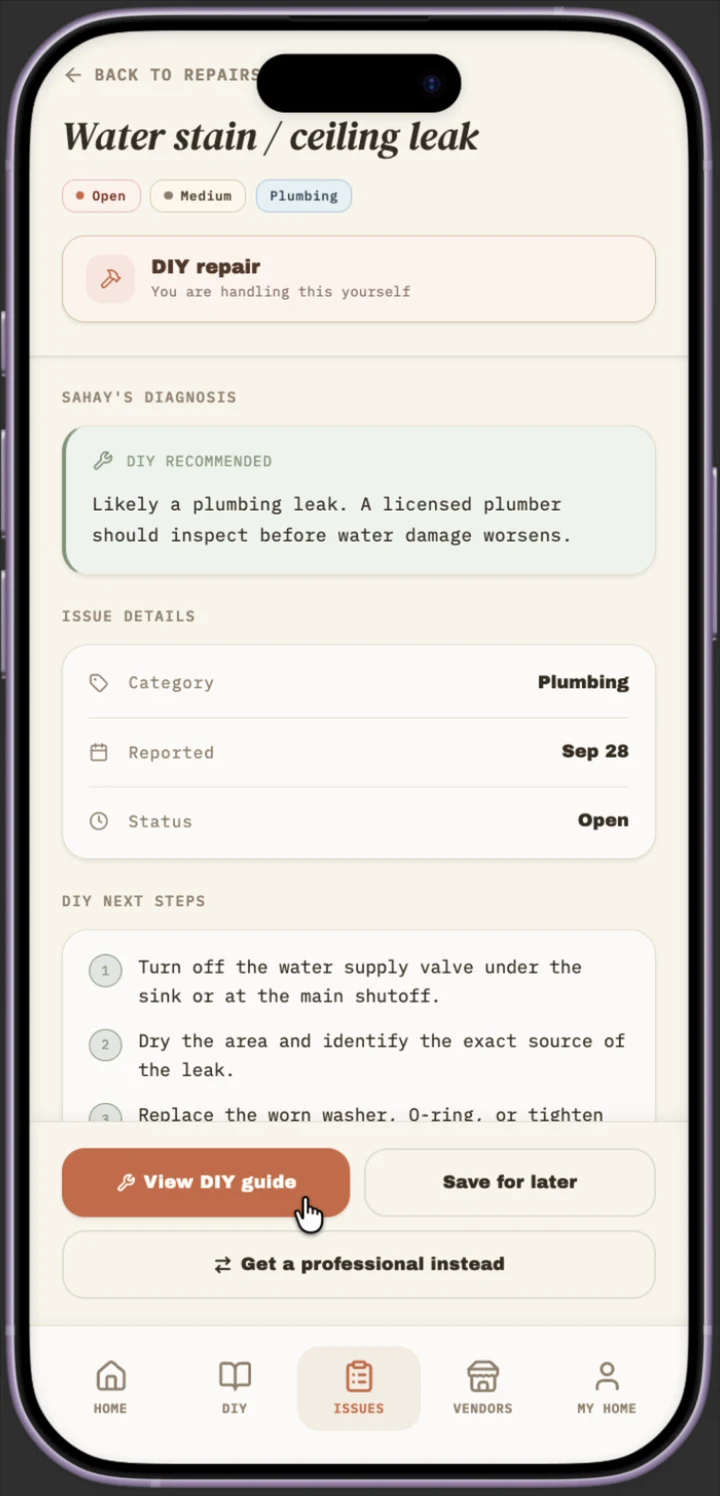
Step-by-step guides by categoryDIY path: numbered next steps, option to switch to a pro
Tracking repairs
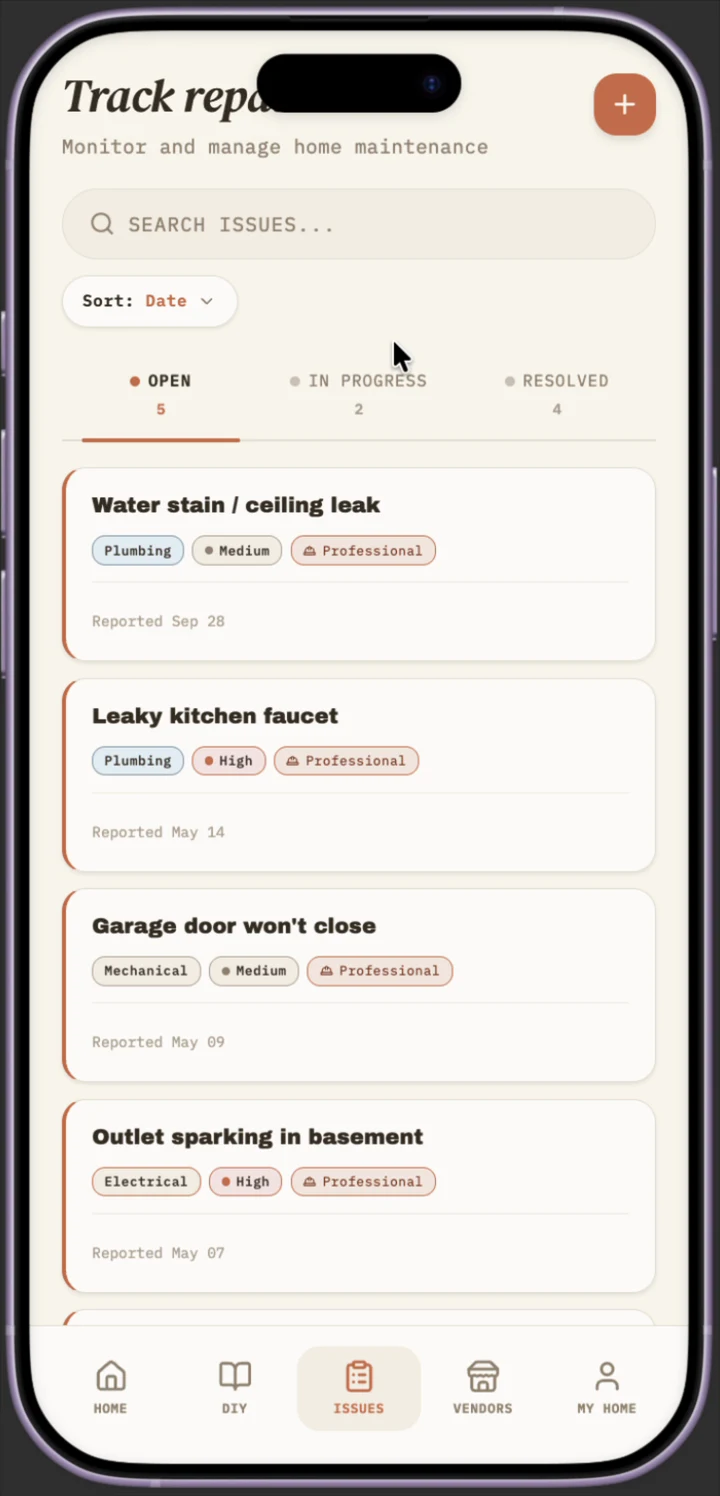
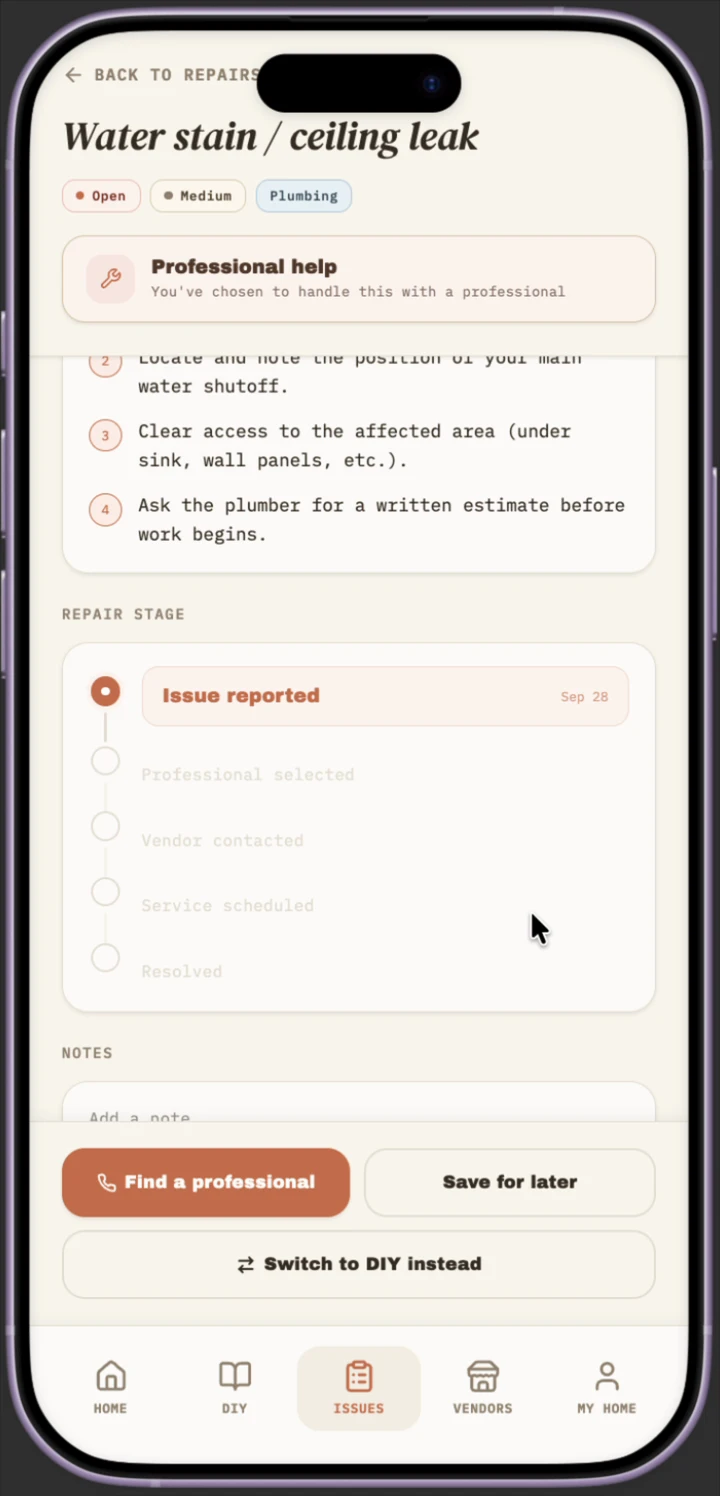
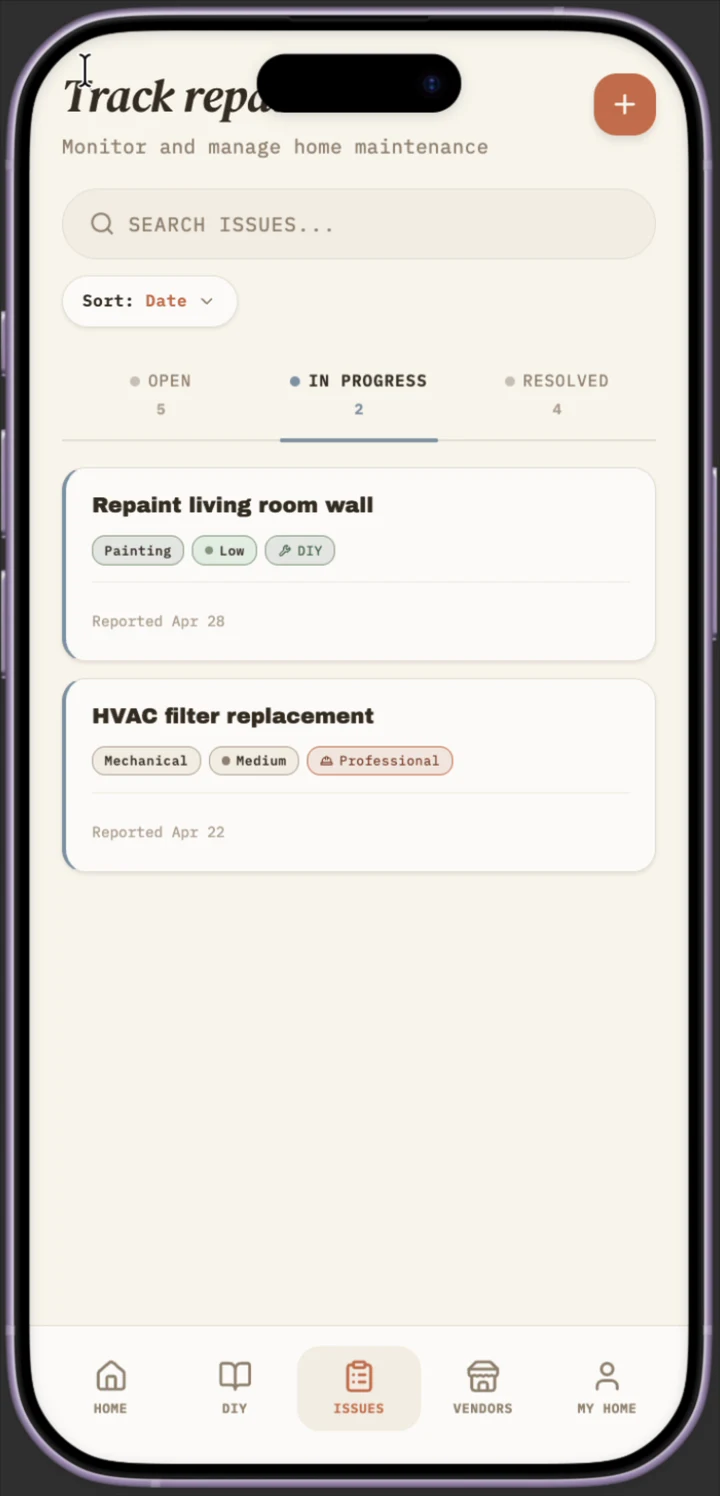
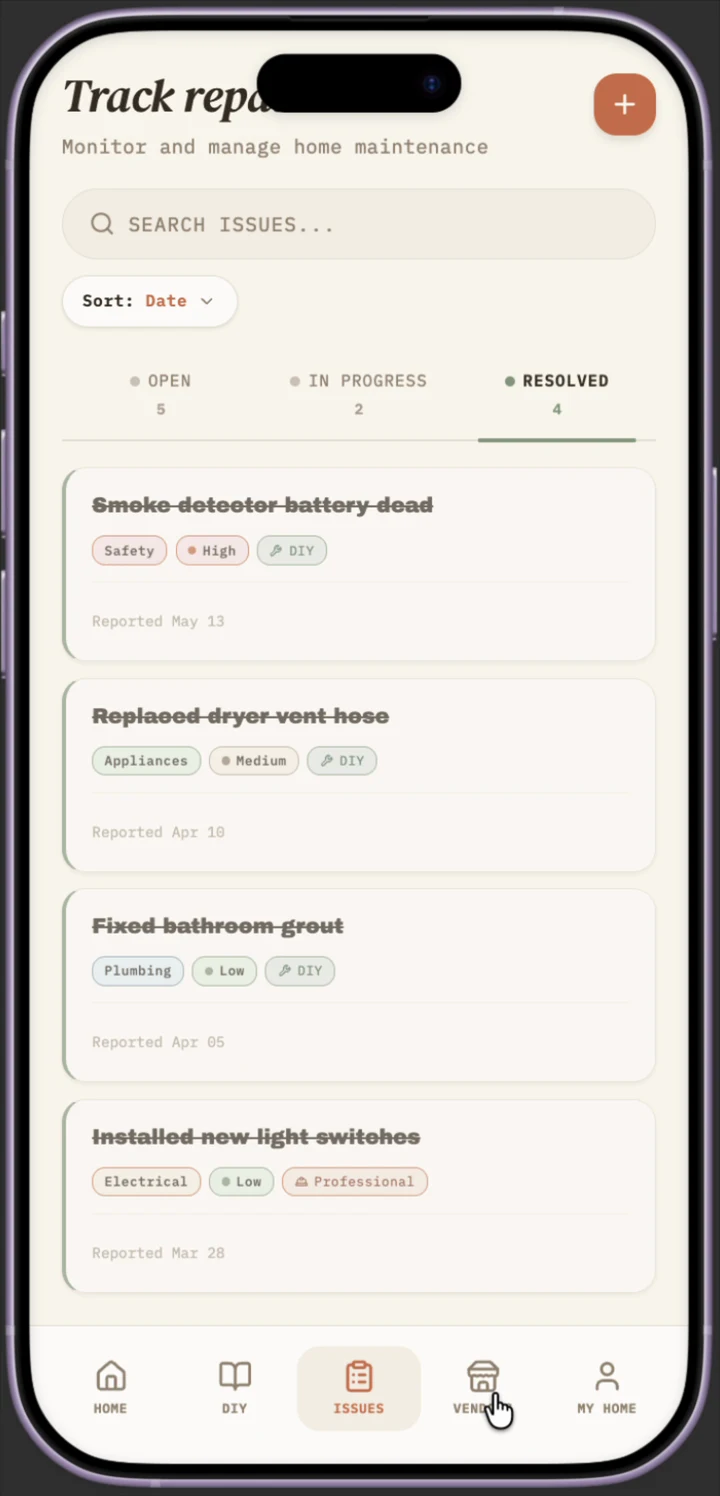
Open issues, at a glanceProfessional path: a visible repair-stage trackerIn progressResolved, kept as a home history
Booking a vendor
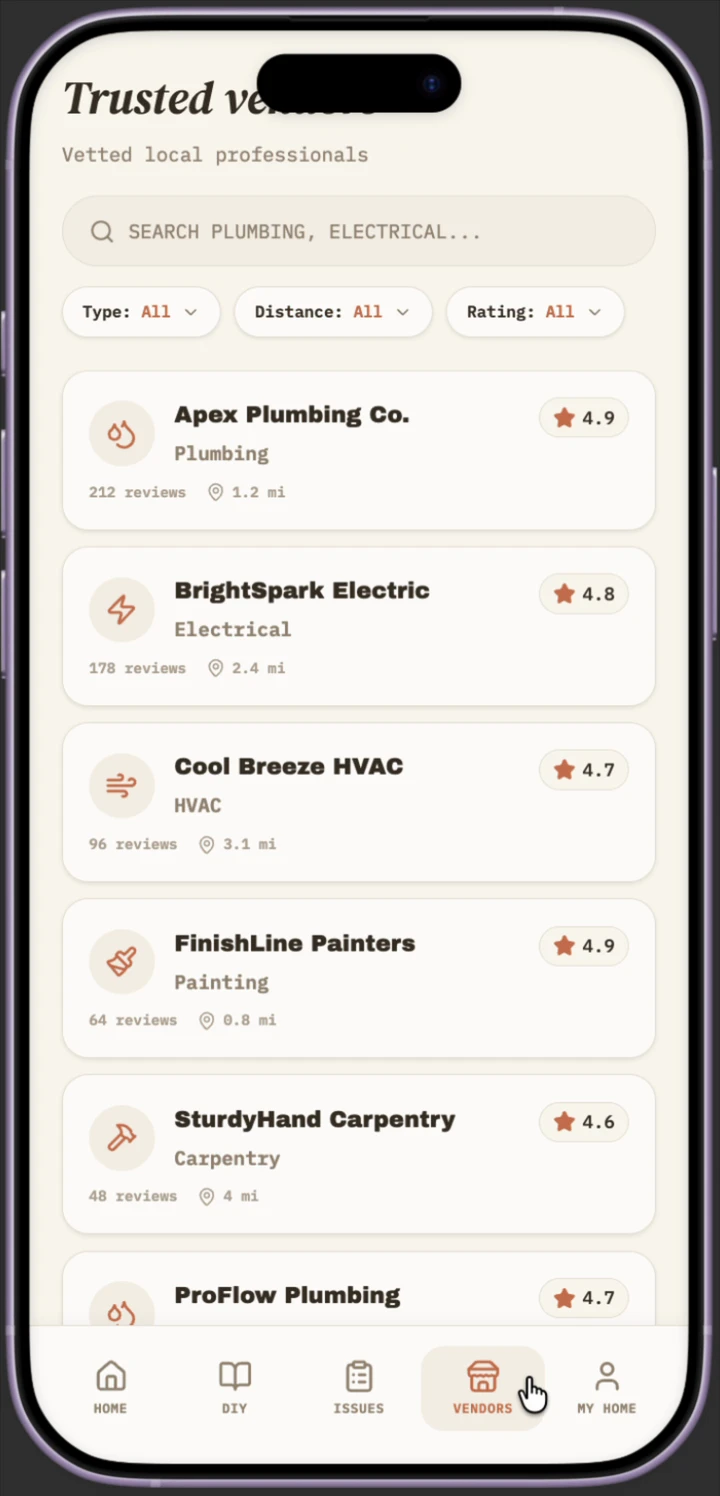
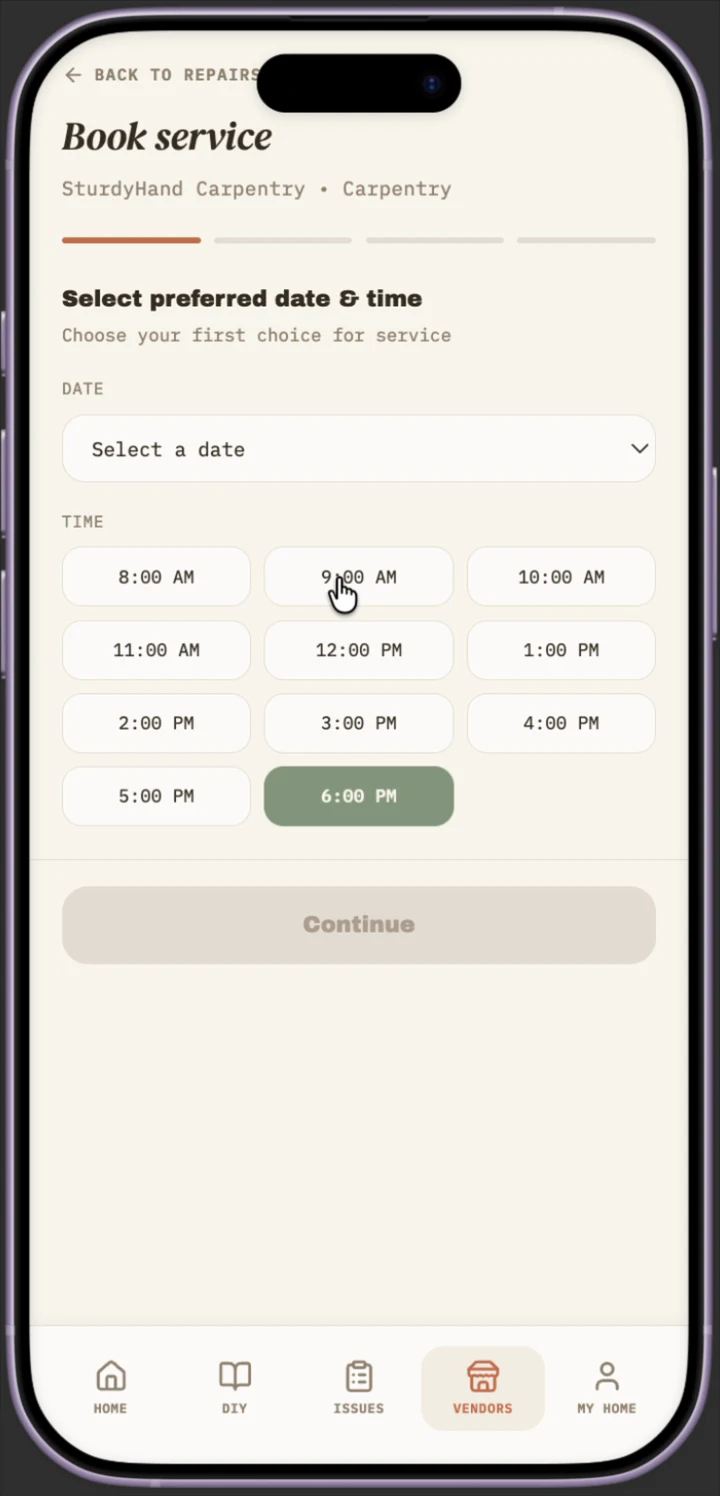
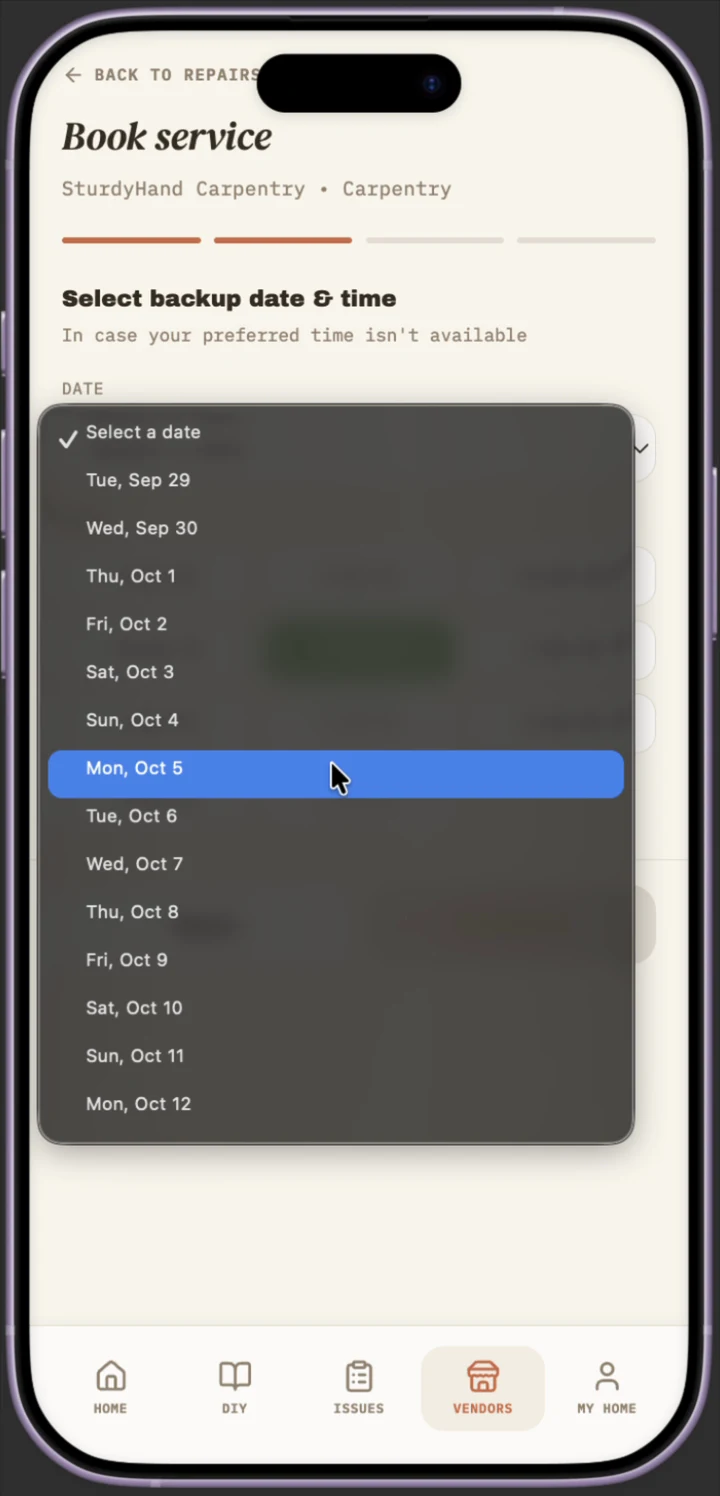
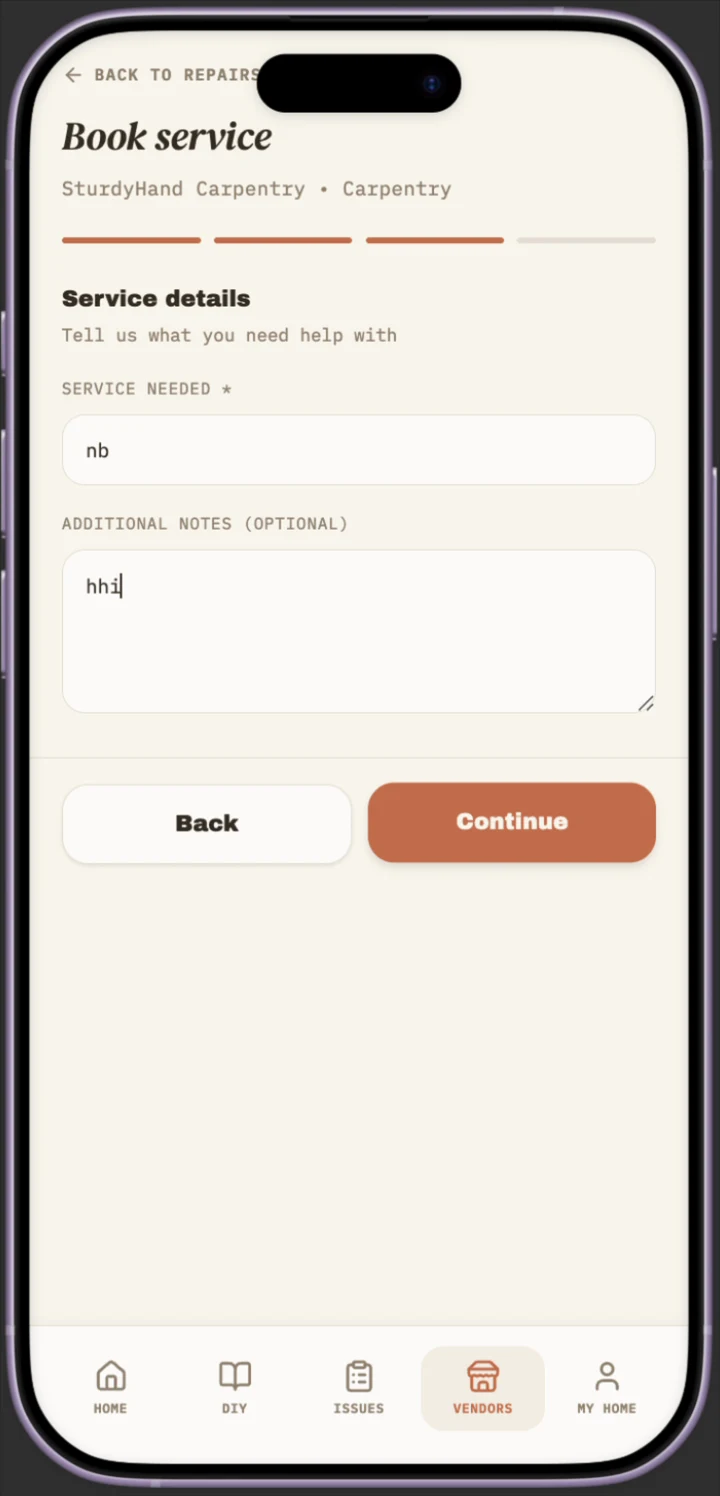
Vendor directory: rating, reviews, distance upfrontPreferred date and timeA backup slot, in case the first falls throughService details, then confirm
My Home & account
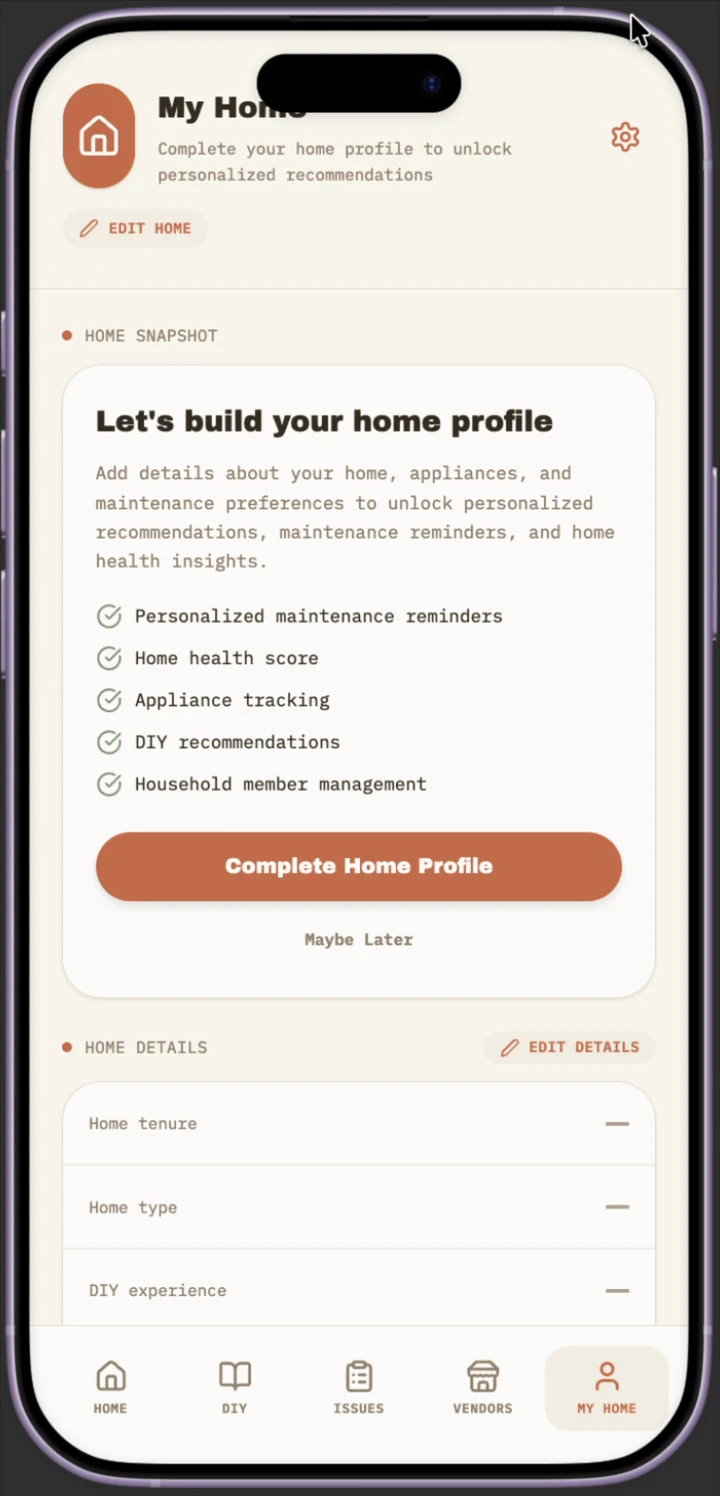
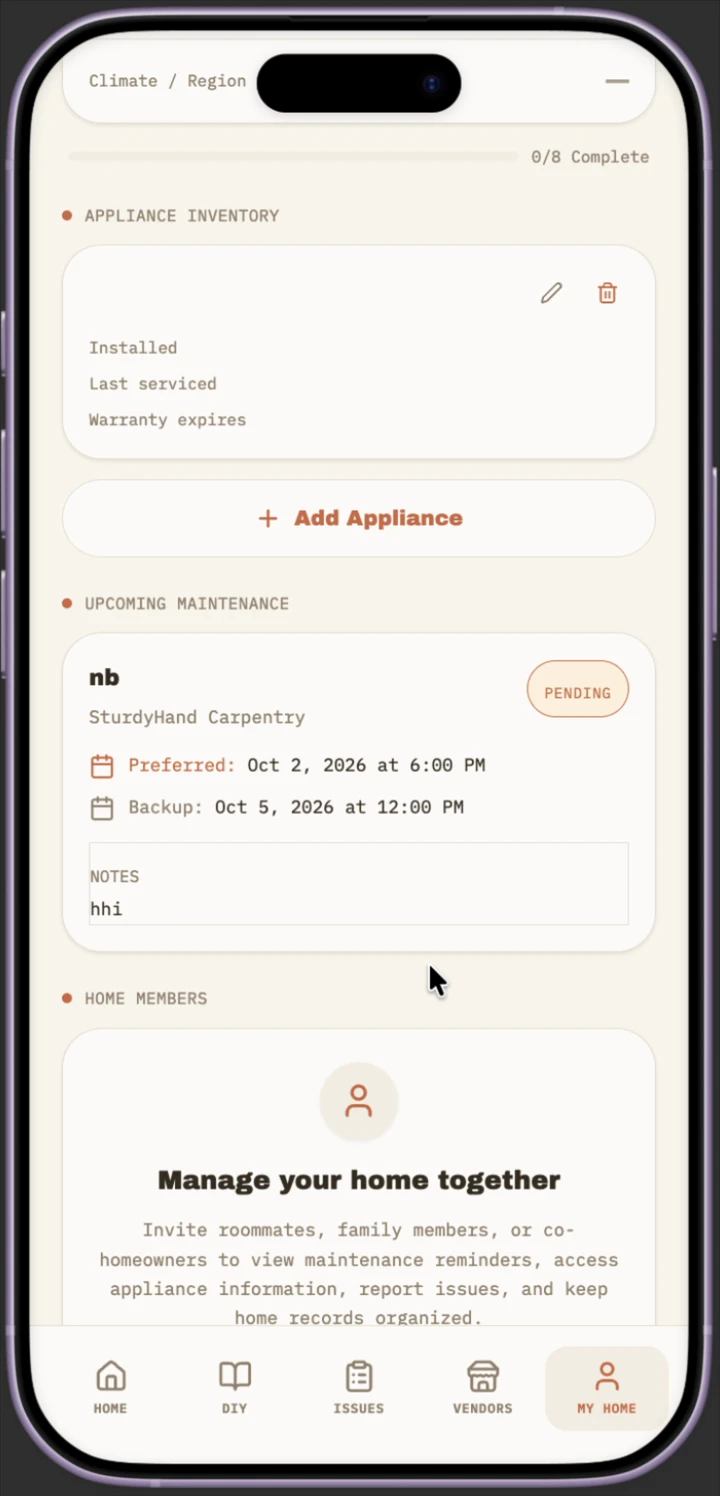
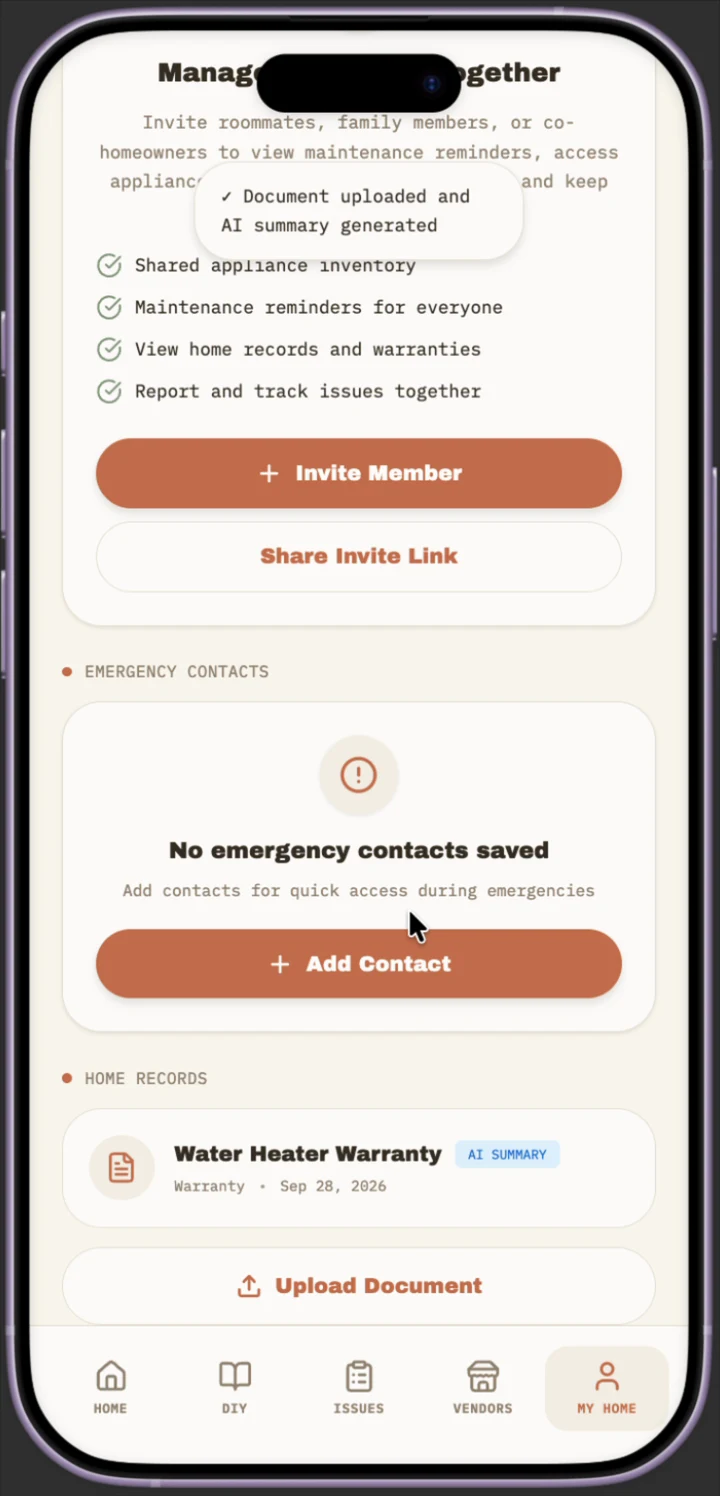
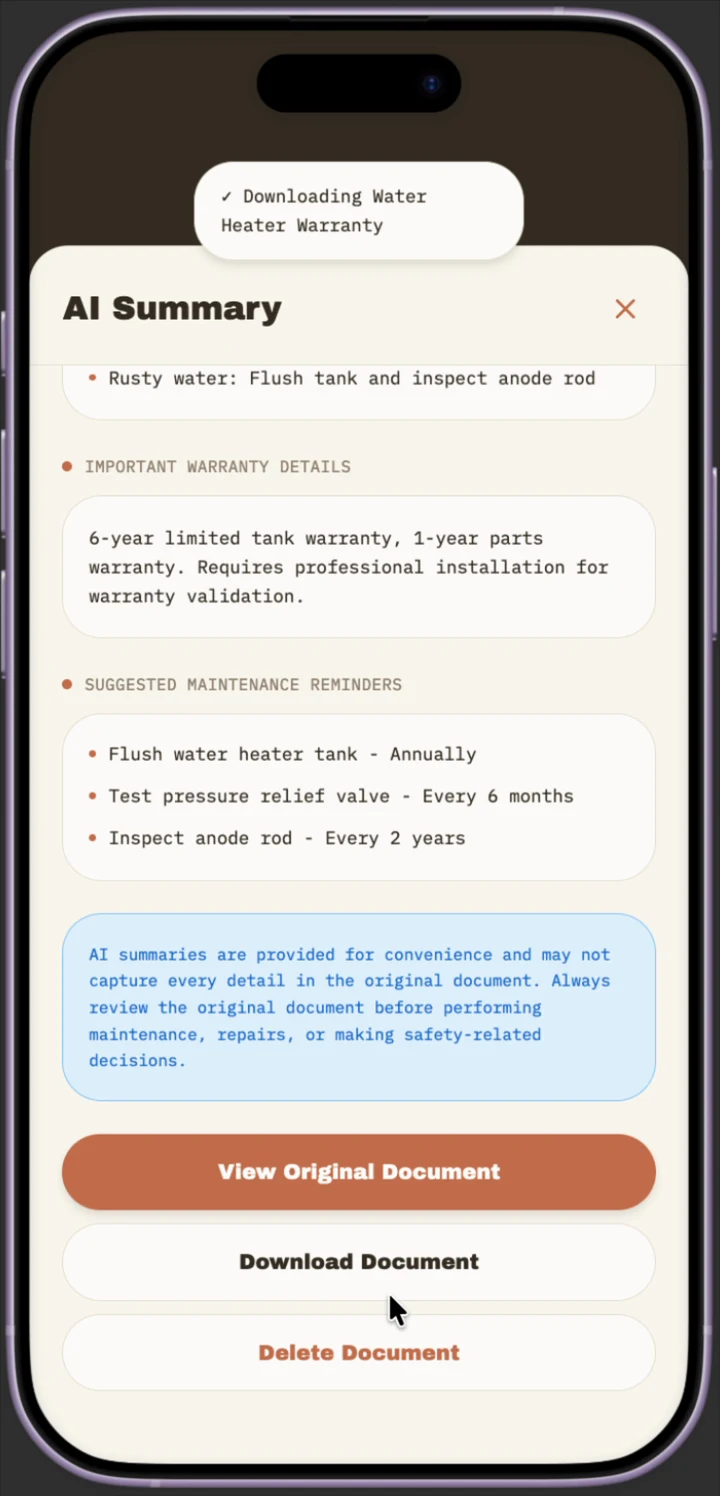
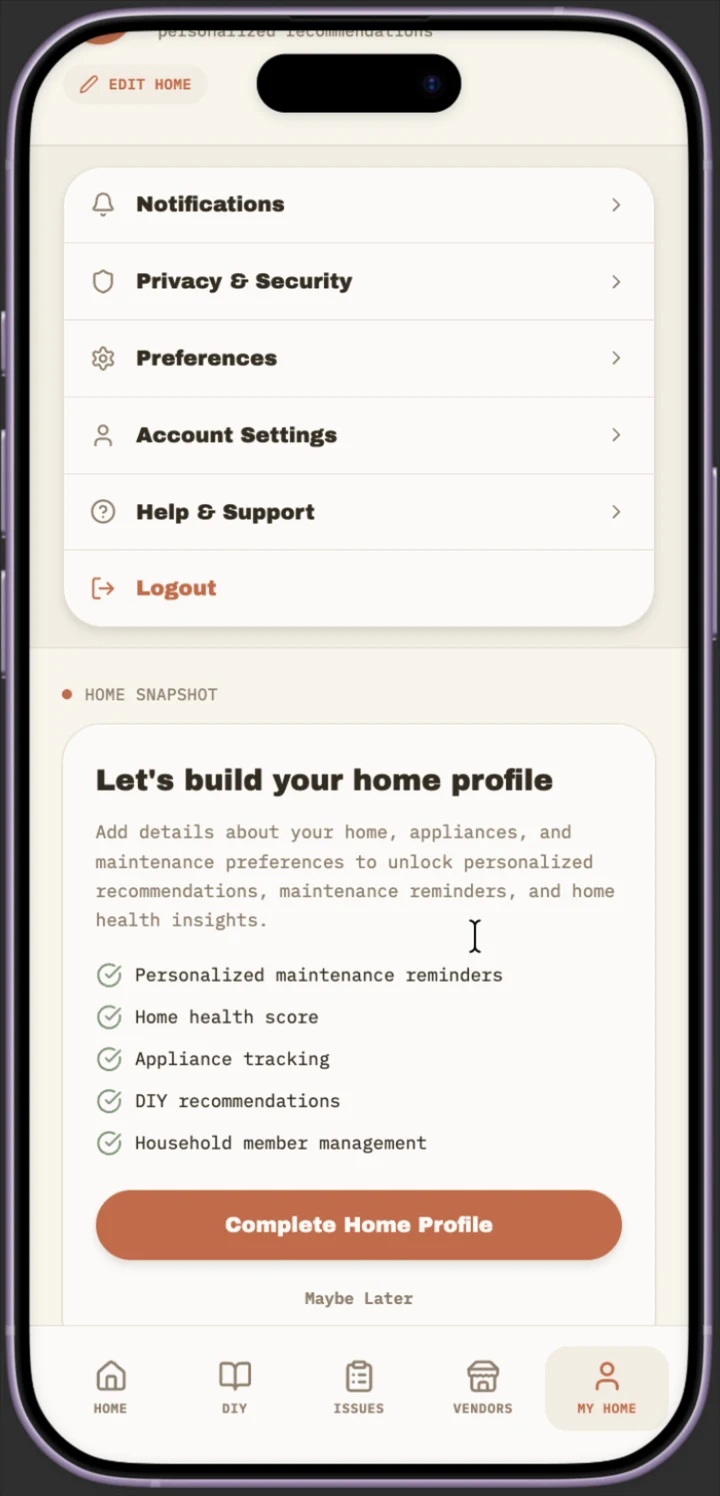
Home profile setupAppliances and upcoming maintenanceShared access, emergency contacts, AI-summarized documentsAI summary of an uploaded warranty documentAccount settings
Visual identity
A warm, trustworthy palette with a hint of editorial confidence.
A bold italic serif for headlines, monospace for labels and body, editorial next to technical. Color stays warm and low-saturation except where a decision needs attention.
Background#F7F4EB
Surface#FCFAF9
Primary accent#C16B4A
Secondary accent#82947B
Tertiary accent#7D90A2
Text#2F2F2F
What's going on at home?
Display & headlines
Bold italic serif, used for every screen title and moment of reassurance.
STEP 1 OF 2 · FULL NAME
Labels, body & UI
Monospace throughout inputs, tags, and navigation, a technical counterweight to the serif.
"I tested the flow with real users, then iterated on where trust broke down."
Round 1, before building anything. I tested the core flow concept with 3 renters in Philadelphia, no UX background, so feedback stayed grounded.
Tested
None had a proactive approach to home maintenance, everyone was reactive.
The AI-first approach and flexible input (photo, voice, text) resonated without much explaining.
DIY-vs-hire was the single most understood, most appreciated part of the flow.
Vendor frustration, too many calls, no pricing upfront, came up with all three. A quote-based in-app approach landed well.
Round 2, on the built prototype. Moderated sessions across 8 tasks, home screen to AI issue reporting, the issue board, vendor booking, DIY exploration, watching for hesitation, misclicks, and whether people trusted the AI.
Tested
🔁
Broken save-for-later
The path between DIY mode and the issue board had a broken step, a loop that could quietly lose a user's place mid-task.
🕒
No real-time availability
The vendor list showed preference, not availability, so testers had to open several profiles just to find someone actually free for an urgent repair.
🐛
"Add Issue" didn't fire
Testers could only log a new issue from the home screen, and the emergency-contact field in the home profile silently failed to save.
⭐
Reviews felt thin
Testers wanted more descriptive, verified reviews and a way to see who'd actually booked through the app, otherwise they defaulted back to Google reviews.
💲
Pricing without duration
An hourly rate range ($45–$65/hr) wasn't enough, testers couldn't tell if a leaking roof would cost $45 or $450.
🔄
AI didn't close the loop
Without a concrete recommendation, testers said they'd still go check YouTube afterward, the flow needed to end in a next step, not just acknowledgment.
What's next
Fixing the broken save-for-later and add-issue loops, building real vendor availability into booking instead of a preference-only match, and deepening the AI's recommendations so a session ends with an actual next step instead of a dead end.